Tag: graphic design

  • The Disappearance of QR Codes

    The Disappearance of QR Codes


    I feel a little ridiculous for believing that fake social media post that claimed we’d run out of QR Codes by 2025. QR codes are not running out, but, they’re not as trendy as they were. Part of me feels vindicated, as a self-identified QR Code hater.

    Two or three years ago, I swear I saw these on a commercial every time I turned on the TV. Are QR codes just a fast fashion trend we all got tired of? 

    I wouldn’t call myself a traditionalist. I like innovation. And yet, I hate QR Codes being used in mainstream graphic design. Maybe because I was ungently pushed towards including them in all my college assignments. We live in a phone-based society, and opening your camera app is easier than having to transcribe a website url. It makes sense. But I have an irrational response to them nonetheless.

    Is it simply because QR Codes are ugly? A lot of designers don’t try to integrate them, they just slap them onto the product—much like a barcode for a commercial product. The design of QR Codes is loud, garish, and can disrupt the flow of a design. I think that most graphic designers would call their work art. I certainly would. I think it’s reasonable to not want something ugly slapped on your art.

    The Anatomy of a QR Code

    But before we can hat is a QR Code? I was genuinely curious. Know thy enemy, and all that. Let’s dive into the anatomy of the QR Code.
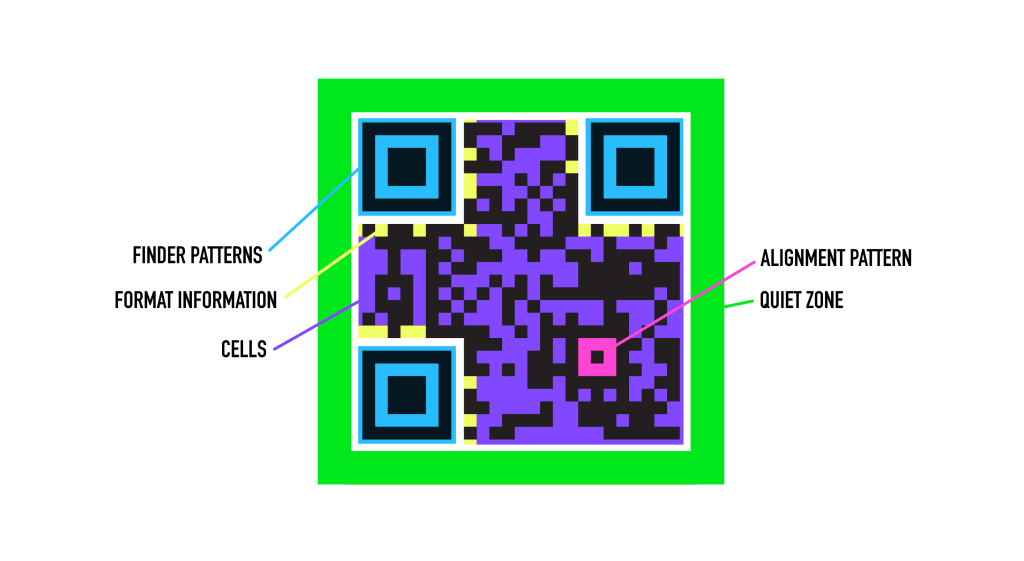
    Finder patterns : the three large eyes in the corners. They orient the QR Code so it can be read correctly.

    Alignment pattern : or, that little nub. It’s a marker that corrects skewing/stretching when a QR Code is being captured on a phone.

    Quiet zone : the blank space that keeps the QR Code separate from the background.

    Format information : a data strip that helps decode the image; has an error correction tool for a QR Code that’s partially damaged.

    Cells : the grid of black and white squares that makes up most of the QR Code. They function like binary code (1 / 0, black / white)
    I think the design of QR Codes is what makes them so ugly to me. They are, by their nature, asymmetrical, with awkward spacing. There’s only so much you can do to make them pretty. They are utilitarian, which is good! But should be accounted for.

    Qr Codes were first created in 1994 by Masahiro Hara and his team at Denso Wave (within Toyota Group) in Japan, to track automobile parts in factories. Currently, QR Codes are used in transportation, banking, customer service, and more.

    I think designers need to ask ourselves: what is enduring? What do people like? Whether it’s QR Codes or any other element. Call me a pastoralist, but I value what is pretty and what is timeless. I mentioned that QR Codes are on the way out, but there may be a resurgence, or another techy element that designers feel the need to take.

  • Are we in a Post-Print Design Landscape?

    Are we in a Post-Print Design Landscape?


    When I was working in my first graphic design job, I remember overhearing a conversation. We were a small non profit with a problem: with sudden funding cuts, we needed to be more cost-effective, and that meant we had to rethink our print operations. That got me thinking: what’s the environmental footprint of designing for print vs digital? Are we moving away from print as designers?

    Unsustainable Print

    Globally, paper (and ink) are major waste sources. Paper is (much of the time) recyclable, but that doesn’t account for the entire print lifecycle: logging, print mills, contaminated paper that has to go to the landfill, toxic products from ink… et cetera.

    In my previous job, printing was also a money drain. For every yearly event, the company had been printing new stationery, including various signs, brochures, table cards, and such… and it was all branded. We couldn’t reuse the signs branded with ‘2023 edition of X event’ in 2024 or 2025. So into the trash it went.

    When the company had to cut down on materials, I think it was a blessing in disguise. We were forced to be smarter, which also translated into a reduced environmental footprint.

    One of the most ingenious concepts from my former company was not only removing the branding on stationery, but creating generalized designs, say, for our long-term sponsors. We could reuse the same signs for different types of events.

    And the kicker is this: in 90% of instances, no one cares about single-use print. This is the distinction between valuable print (sponsor signs, print for event spaces, specialty magazines) and stuff that ends up in a landfill–your brochures, your flyers, your business cards, your place cards, your branded swag.

    But What About Digital?

    Molly, you might say (if you’re keeping tabs with the news/AI), digital media also has an environmental tax. That’s certainly true. But services like Adobe Cloud are demonstrably reducing the carbon footprint of design tasks; digitally shareable and signable documents are a huge part of this, not just in design but in all fields.

    AI Is its own beast that I will talk about later on in depth–and yes, it is an issue, but a separate one. Here I’m talking about print vs digital terms of logistics. You’re actually saving money by switching to digital. Win-win. AI (in design) is primarily about productivity/capital gains and, although it’s environmentally harmful, it’s got a lot of perks for employers.

    The future of print

    I don’t want it to sound like I’m an anti-print crusader. Physical media is important. Digital has some pitfalls: power/electricity outages, and in some cases being less accessible. There are times where digital media just doesn’t deliver in the way print can. In my house: print books over Kindle, for life.

    I think we’re already seeing the disappearance of a lot of single-use paper/physical materials. In my own recent experience, I’ve done a lot of designing for Instagram and slideshow… meanwhile, I pretty much have forgotten how to prep a document with die lines for print. I’m kidding! (Not really)

    I think print will become its own niche/specialty in design, rather than something every designer deals with on a regular basis. I may be off the mark, but who knows?