I have never worked a stable full time job.
It’s true. I’ve done part-time retail in summertime; and after I graduated college, I was hired as a contract graphic designer and subsequently worked two years on-and-off until my employer lost funding for my position.
Since I was let go from my job in late February 2026, I have become a long-term job seeker. I have done months of specialized employment training. I have applied to an absurd amount of online listings, gotten a paltry handful of interviews, and attended Ottawa’s biggest youth job fair.
In that half year of work, I have, by an outsider’s perspective, done a lot—just about everything I could do to get a job. Making custom cover letters and resumes. Using LinkedIn, Instagram, refurbishing my website. Reaching out to past professors. Meeting one-on-one with professionals in my field. Picking brains.
What I’m beginning to understand is that there are factors that are outside of my control. We are, indisputably, living in a youth unemployment crisis. Companies are using AI, automating, or outsourcing. Junior graphic design positions are few and far in between as a result. This cohort of young, newly educated people coming out of university has an infeasible challenge ahead, where they are competing not only with each other, but with older, more experienced designers.
“This cohort of young, newly-educated people coming out of university has an infeasible challenge ahead, where they are competing not only with each other, but with older, more experienced designers.
…That is, unless you know how to network. Part of networking is privilege. Having access to recruiters, having certain qualifications. People who are new immigrants, financially insecure, disabled, neurodivergent, and/or otherwise unable to be the ‘social chameleon’ are at a major disadvantage. Networking by your own volition is HARD.
Which is why I wish my college professors gave us more guidance in that regard. This isn’t unique to graphic design; I think all students would be better prepared if each degree had a dedicated networking course, mentorship opportunities, and special events. I was doubly affected by entering college in the midst of the pandemic, and my first year of three was almost entirely virtual. I wish the social gaps had been addressed, because as much as I enjoyed learning about graphic design and making fun projects, I was naive about the reality of the working world. A good portfolio won’t get you far if you don’t know where to look. Even with spam-applying to jobs on Indeed or LinkedIn, odds are you’ll get burnt out before you get an interview. (I will say this: my school’s alumni job postings group was/is very helpful!)
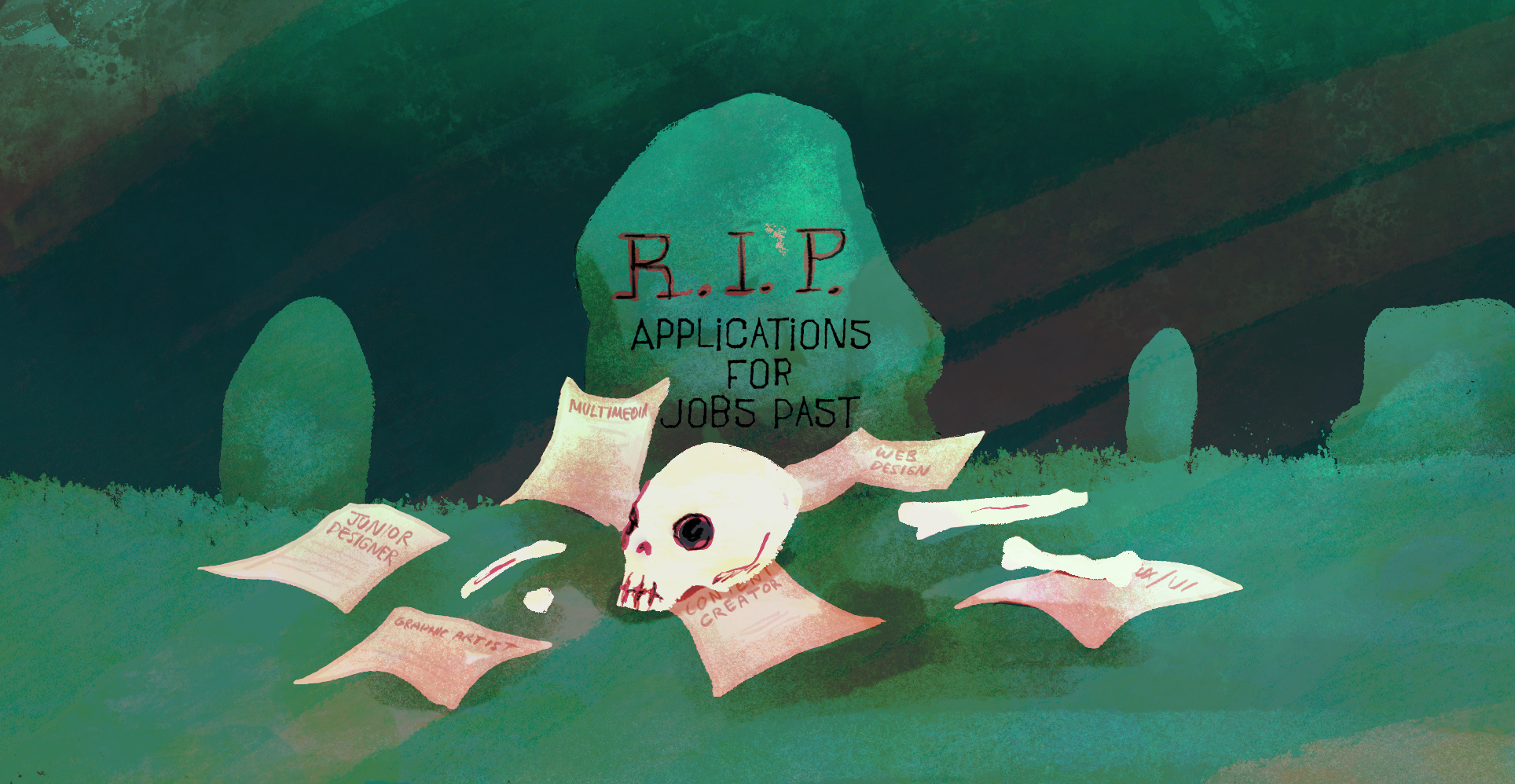
I also want to talk about the mental toll of applying to jobs and hearing nothing back. It’s very difficult to describe how much mental fortitude is required as a full-time job seeker. It’s a thankless process: maximum effort with minimal gain, sort of like being in a very deep, very wide hole where you’re looking for a rope, but it’s so dark you can’t see a thing.
It’s easy to question your skills and your work ethic because the world of job applications is so heartless. I know my work has value, but it’s something I have to remind myself of constantly.
Here’s my tips for anyone caught in the graveyard of applications:
1: Employment insurance. People who lose their jobs involuntarily can usually qualify for benefits. Don’t be like me and put it off indefinitely!
2: Employment services. Working with Employment Ontario lifted a big weight off my shoulder: I got one-on-one help on my resume, interviews, and other job skills, all for free.
*Addendum: Graphic design is specialized, and not all advice from job counsellors will necessarily apply to the industry. This is why it’s great to have a mentor figure who’s in an arts-related job.
3: Networking. There are specific events for nearly everyone: youths, women, minority groups, etc., and they can be really fun. Look on Eventbrite or Instagram.
4: Self-care. This is the most important step. Never neglect your basic needs. Always have something to look forward to, something totally separate from your job search and your career development as a whole. Job application burnout is real. Post-interview burnout is also real. Take breaks! Your body and mind will thank you.
That’s all from me. In other news… Happy (early) Halloween. I’ll be baking, and preparing my next blog post with my Inktober drawings.


Leave a Reply